


A few months ago, I was introduced to a concept called “glass child” that I saw on social media. I did a few Google searches about it, and I found out that it was an informal term used to describe the healthy sibling of a child with a disability or special needs. Oftentimes, the healthy sibling is overlooked (or feels overlooked) because parents have to exert more effort or give an unfair amount of attention to the special needs child.
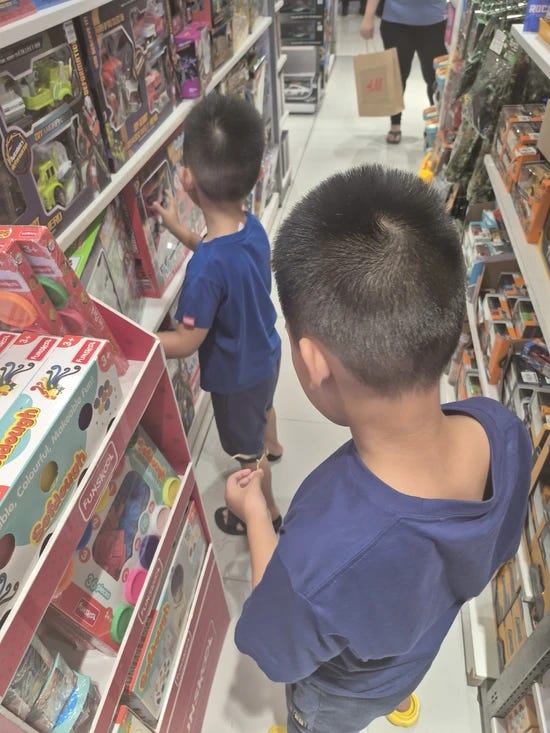
I was immediately struck by it because, finally, I found a term for one of the things that I fear most for my neurotypical boy, and that is harboring feelings of envy and resentment for his Kuya if we are not careful. I was afraid that we were giving too much attention to Miguel and overlooking our youngest, Rafa.
There were instances that I observed it happening in my family, moments in which Rafa would ask, “Bakit si Kuya pwede…”, “Bakit si Kuya ganito….”, “Bakit si Kuya ganyan…”, “Mas love mo si Kuya.”
During those times, we could only explain to our little boy that sometimes, we just have to be a little more lenient or even more generous to his Kuya because Miguel is different. Miguel wasn’t like him; he couldn’t talk yet, and he couldn’t understand things the way that we perceive our surroundings.
Marami rin moments na nasasaktan ako para sa bunso ko. Kung minsan, iniisip ko na baka nagsasabi na lang sya ng “yes” sa mga requests and lessons namin sa kanya just to please us.
That’s why, beyond those emotionally charged moments, even in our normal conversations, I explain to Rafa that his Kuya is different and may need more understanding from us. He may need more patience from us for us to comprehend his needs because he can’t talk yet.
Today, we had another trying moment for our little boy. One of Rafa’s “diamond paintings” caught the attention of Miguel because it had texture. It had embossed “diamond” stickers, and Miguel thought it amusing to pry away each sticker. Literal na tinungkab n’ya isa-isa yung mga diamante na pinagt’yagaan ni Rafa idikit last weekend. Natural nagalit ang bata, and he kept saying, “Nakakinis naman si Kuya!”
Then about 15 minutes after that, Miguel shook the butaka chair in which I put down Rafa’s school bag. The bag fell, and together with it, his water bottle tumbled down. The cap popped open, spilling its contents on the floor.
Again, Rafa shouted. “Daddy, tingnan mo o. Si Kuya na naman. Nakakainis talaga s’ya!”
I hugged Rafa and told him not to be too hard on his Kuya. Sabi ko na rin na huwag s’ya maiinis. Hindi pa naman kasi naiintindihan ni Kuya yung mga actions n’ya kaya talagang may mga moments na magkakamali pa rin talaga s’ya.
We need to understand Kuya because he is not like us. Okay lang na ma-frustrate s’ya dahil right naman n’ya yun, but don’t use that emotion para tuluyang magalit or eventually kamuhian n’ya si Kuya n’ya or to feel na mas favored namin ang brother n’ya.
At times, I explain to Rafa that he also has a big role to play in caring for his Kuya, without it sounding like a burden to him. I don’t want him to feel that his Kuya will be his responsibility in the future. He has his own life to live and dreams to fulfill when he grows up. However, just check on his Kuya from time to time to make sure that he’s alright.
Lastly, I try to spend more time carefully explaining to Rafa his Kuya’s condition and how we need to be extra understanding of Kuya.
Of course, so that Rafa doesn’t feel neglected, we also emphasize that we love him and that Mommy and I love both of them very much.
Similar stories: